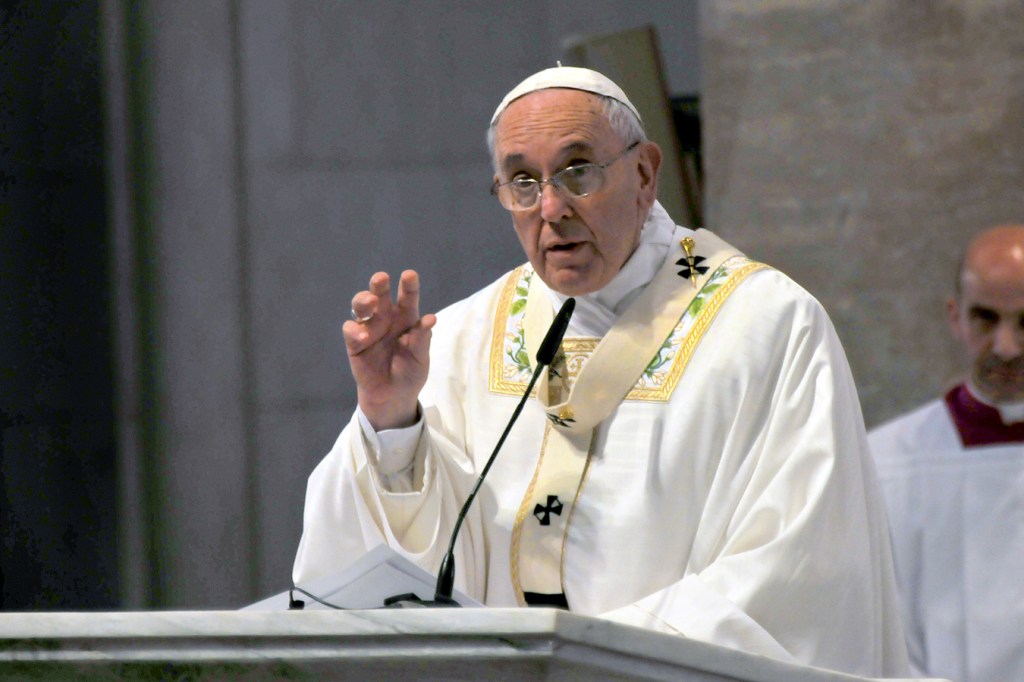
Pope Francis delivers his homily during Mass at the Manila Cathedral on Jan. 16, 2015. (Photo: Roy Lagarde)
By Pope Francis
January 16, 2015
Manila, Philippines
MANILA— Below is the full text of Pope Francis’ homily during the Mass with bishops, priests, and consecrated persons at the Manila Cathedral on January 16, 2015:
“Do you love me?” [The people respond: “Yes!”]
Thank you, but I was reading the word of Jesus! The Lord said: “Do you love me?… Tend my sheep” (Jn 21:15-17). Jesus’ words to Peter in today’s Gospel are the first words I speak to you, dear brother bishops and priests, men and women religious, and young seminarians. These words remind us of something essential: All pastoral ministry is born of love. All consecrated life is a sign of Christ’s reconciling love. Like Saint Therese, in the variety of our vocations, each of us is called, in some way, to be love in the heart of the Church.
I greet all of you with great affection. I ask you to bring my affection to your elderly and infirm brothers and sisters and to all those who cannot join us today. As the Church in the Philippines approaches the fifth centenary of its evangelization, we express gratitude for the legacy left by the bishops, priests, and religious of past generations. They labored not only to preach the Gospel and build up the Church in this country but also to forge a society inspired by the Gospel message of charity, forgiveness, and solidarity in service of the common good.
Today, you carry on that work of love. Like them, you are called to build bridges, pastor Christ’s flock, and prepare fresh paths for the Gospel in Asia at the dawn of a new age.
“The love of Christ impels us” (2 Cor 5:14). Saint Paul reminds us in today’s first reading that the love we proclaim is a reconciling love, flowing from the heart of the crucified Savior. We are called to be “ambassadors for Christ” (2 Cor 5:20). Ours is a ministry of reconciliation, proclaiming the Good News of God’s infinite love, mercy, and compassion—the joy of the Gospel. For the Gospel promises God’s grace, which alone brings wholeness and healing to a broken world and inspires the creation of a just and redeemed social order.
Being an ambassador for Christ means inviting everyone to a renewed personal encounter with the Lord Jesus (Evangelii Gaudium, 3). This must be central to the commemoration of the evangelization of the Philippines. But the Gospel also calls for conversion and an examination of conscience, both as individuals and as a people. As the Bishops of the Philippines have taught, the Church is called to confront deeply rooted inequality and injustice in Filipino society, which contradict the teachings of Christ. The Gospel challenges individual Christians to live with honesty, integrity, and a concern for the common good.
At the same time, Christian communities are called to create “circles of integrity,” networks of solidarity that can transform society through their prophetic witness.
The poor are at the center of the Gospel. If we remove the poor from the Gospel, we cannot understand Jesus’ message. Bishops, priests, and religious, as ambassadors for Christ, must be the first to welcome His reconciling grace. This requires rejecting worldly perspectives, embracing daily conversion, and allowing God’s word to challenge our complacency, fear of change, and compromises with the world.
For priests and consecrated persons, conversion to the Gospel’s newness means encountering the Lord daily in prayer. Community life and apostolates must foster a closer union with the Lord in perfect charity. Living the poverty of Christ, focused on God’s will and service to others, combats materialism and empowers us to identify with the least among us.
I address young priests, religious, and seminarians: share the joy and enthusiasm of your love for Christ with others, especially your peers. Be present to young people confused or disheartened, those burdened by poverty and corruption, or those tempted to leave school or live on the streets. Proclaim the beauty and truth of the Christian message in a society tempted by distorted views of sexuality, marriage, and family.
Filipino culture, shaped by the imagination of faith, is known for its love of God, fervent piety, and devotion to Our Lady and her rosary. This heritage holds powerful missionary potential. As you prepare for the fifth centenary, build upon this foundation.
Christ died for all so that we might live no longer for ourselves but for Him (2 Cor 5:15). I ask Mary, Mother of the Church, to obtain for all of you an outpouring of zeal. May you dedicate yourselves in selfless service to your brothers and sisters, allowing the reconciling love of Christ to penetrate Filipino society and reach the farthest corners of the world.
Amen.

