By Leo Francisco
This is not just another article. This is my personal commentary—a reflection from the heart, born out of righteous anger, deep solidarity, and a longing for justice.
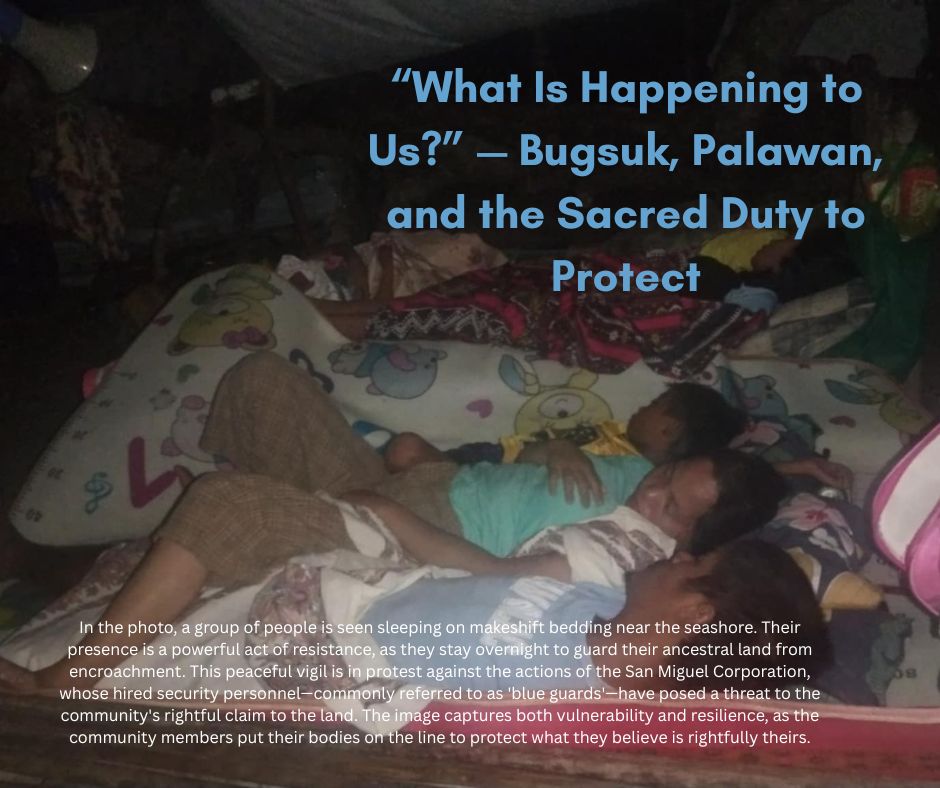
Why must the indigenous people of Bugsuk Island in Palawan fight to secure the land that has been theirs for generations, while powerful corporations like San Miguel Corporation act as though they own it? These lands are not just parcels of property; they are sacred—woven into the people’s identity, livelihood, and memory.
And yet, these lands are being seized, fenced off, and converted into profit—not to uplift the people, but to displace and exploit them. The land is being treated as a commodity, not as a common good. And that is a sin against both creation and humanity.
What the Law Really Says
As a Filipino, I cannot ignore what our Constitution and legal system already say.
Under Article II, Section 22 of the 1987 Philippine Constitution:
“The State recognizes and promotes the rights of indigenous cultural communities within the framework of national unity and development.”
And under Republic Act No. 8371, the Indigenous Peoples’ Rights Act (IPRA) of 1997, it is declared:
“Indigenous peoples have the right to ancestral domains and lands, to develop and control these lands in accordance with their customs, traditions, and institutions.”
So when a powerful corporation encroaches upon ancestral domains without Free, Prior, and Informed Consent (FPIC), it is not just a procedural error—it is a violation of human dignity.
Every public official in our country also takes an oath:
“To faithfully and conscientiously fulfill my duties as a public official… and to uphold and defend the Constitution.”
To remain silent or complicit in these corporate land grabs is to betray that very oath.
Faith Demands Justice
As someone formed by Catholic social teaching, I take to heart the words of Pope Francis in Laudato Si’ (§146):
“The land is not a commodity but rather a gift from God and from our ancestors who rest there, a sacred space with which they need to interact if they are to maintain their identity and values.”
The Church teaches us about the preferential option for the poor—that the needs of the marginalized, like the indigenous peoples of Bugsuk, must come before corporate interests.
As Pope John Paul II once said to Indigenous Peoples:
“You are not alone. The Church is with you. Christ is with you.”
I echo this conviction. We must be with them—not just in sentiment, but in action.
Wisdom from Other Traditions
This is not just a Christian concern. All faiths recognize the sacredness of the earth and the dignity of people.
In Islam, the Prophet Muhammad (peace be upon him) said:
“The earth is green and beautiful, and Allah has appointed you as His stewards over it.”
(Hadith, Sahih Muslim)
In Buddhism, the practice of Right Livelihood and compassion for all beings prohibits exploiting the land and the poor.
In Indigenous spirituality, the land is not owned, but belonged to. Human beings are not masters, but guardians. The land is a sacred trust passed down through generations.
A Cry from the Heart
So I ask—what is happening to us?
Why is the law not applied to protect the powerless, but seems to falter before power?
Why are oaths of office treated so lightly, while the cries of the displaced are so easily ignored?
The people of Bugsuk are not simply defending their land. They are defending their dignity, their memory, their right to exist in peace.
And I can’t help but ask:
- What if these people weren’t brave enough to fight for their lives?
- What if no Ateneo organization cared enough to listen?
- What if the Church remained indifferent?
- What if there were no protest, no walk for peace, no one to stand up?
In this era of Artificial Intelligence, economic obsession, and digital distractions, it seems people care less about the sacred details of history, and more about profit—even if it means erasing lives and selling off ancestral lands.
But how about this: What if we stood united instead?
Let us protect Mother Nature and stand in solidarity with those who wish only to live peacefully—those who are not asking for AI innovation or corporate development, but only for the right to live in the land that has always been theirs.
If San Miguel Corporation aims to turn Bugsuk into a tourism destination, then maybe it should first learn the meaning of “knowing your place.” Because in truth, they are the outsiders. The indigenous people are the true keepers of that land.
A Final Word
This commentary is my voice, but I hope it becomes part of our collective conscience.
To speak out is not just activism—it is a form of discipleship, of citizenship, and of human decency.
Let us not stay silent.
Let us not be indifferent.
Let us be accountable to the land and to one another.
Leonard “Leo” Francisco
Currently the Assistant Content Creator for the website and social media pages of the Society of Jesus’ Social Apostolate under the leadership of Fr. Emmanuel Alfonso, SJ. He is a seminarian under regency while pursuing his theological and masteral studies at the Loyola School of Theology, Ateneo de Manila University.

